
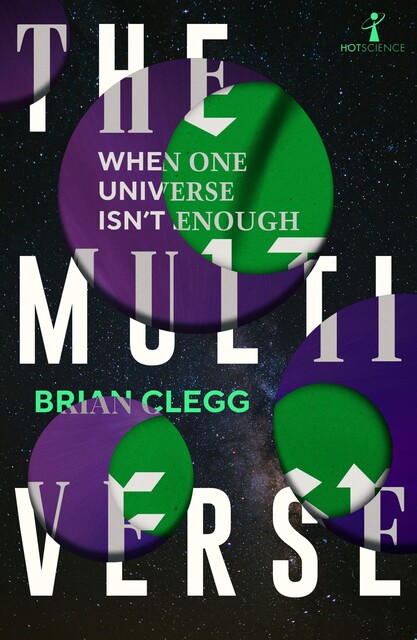
The Multiverse
- Hakkında
- İzlenimler2
- Alıntılar864
- Okuyucular63
- İlgili kitaplar
- Mihai Madalina elenaalıntı yaptı7 ay önce
 Despite the hype, Two New Sciences made a far bigger contribution to science than Galileo’s infamous book comparing the Copernican, sun-centred universe with Aristotle’s Earth-centred system.
 - Mihai Madalina elenaalıntı yaptı7 ay önceThe traditional rendering of Aristotle’s view was ‘nature abhors a vacuum’.
- Mihai Madalina elenaalıntı yaptı7 ay önceBacon had in mind wheels of cheese, rather than wedges.
- Mihai Madalina elenaalıntı yaptı7 ay önceWe can also make use of particles other than photons, such as neutrinos, to make some astronomical observations, but electromagnetic methods dominate.
- Mihai Madalina elenaalıntı yaptı7 ay önceWe will come back to a multiverse based on bubble-like structures when we’ve established a potential scientific basis for it. But first we need to consider an even simpler way of bringing a multiverse into being. By going virtual.
- Mihai Madalina elenaalıntı yaptı7 ay önceThis all presumes a single universe. One relatively simple form of multiverse can again be imagined by starting in two dimensions. Think of a tray filled with flat soap bubbles, leaving no gaps. In a finite tray, any bubble could expand if other bubbles contracted. Alternatively, in an infinite tray, all the bubbles could expand without any contraction. If we extend each bubble to three dimensions the same could apply to a multiverse.
- Mihai Madalina elenaalıntı yaptı7 ay önceSimilarly, a three-dimensional space could in principle be warped through another dimension so that any attempt to leave it results in re-entering from the other side. Getting to this viewpoint for a three-dimensional space is more of a stretch of the imagination – but it is mathematically possible (and bear in mind that the general theory of relativity makes it clear that space can be curved as much as we like). You could envisage what might happen if you travel outwards from Earth for far enough: you would eventually come back into the universe from the ‘other side’, never having left it – even though the higher-dimensional manipulation required to make this happen is beyond direct imagining.
- Mihai Madalina elenaalıntı yaptı7 ay önceThis may sound impossible, but we are very familiar with the concept of something being finite but unbounded when considering a two-dimensional surface existing in three-dimensional space. Think, for instance, of the surface of the Earth. It is definitely finite: travel around its equator and you will come back to your starting point in around 40,000 kilometres (25,000 miles). You can reach any point from any other after travelling a finite distance that is no more than half this distance. But the Earth’s surface has no boundary, no ending. You can travel around it for ever without coming to the edge.
- Mihai Madalina elenaalıntı yaptı7 ay önceOne of the possibilities at the heart of the general theory of relativity is that space (and time) can be curved. In principle a finite universe could be curved in such a way that it does not have boundaries – the case mentioned earlier of it being finite but unbounded.
- Mihai Madalina elenaalıntı yaptı7 ay önceThe reality is that we can’t know how big the universe is, and though we aren’t aware of anything physical that is infinite, arguably the universe is one thing that could be … because what would stop it being so? There certainly is an attraction to living in an infinite universe, because it deals with the problem that went back to the Ancient Greeks. If it’s finite, what happens at the edge? If you were in a spaceship and reached the edge, what would happen if you continued in a straight line?
fb2epub
Dosyalarınızı sürükleyin ve bırakın
(bir kerede en fazla 5 tane)